IMPORTANT PEOPLE
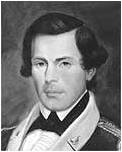
MAJOR SAMUEL NICHOLAS, CONTINENTAL MARINES
Samuel Nicholas was the first officer commissioned in the Continental Marines, and, by tradition, is considered to be the first Commandant of the Marine Corps. He was born in Philadelphia in 1744.His commission as a captain, signed by John Hancock, President of the Second Continental Congress, was dated 28 November 1775, 18 days after the recognized birth of the Corps itself. Promoted to major in June 1776, Nicholas led his small Corps with distinction throughout the Revolution, including command of the landing force which captured New Providence and service with Washington's army at the Battle of Princeton. With the disbandment of the Marine Corps and Navy at the end of the Revolution, Major Nicholas returned to civilian life. He continued to reside in Philadelphia, dying there on 27 August 1790, and was buried in the Society of Friends Cemetery.

LIEUTENANT COLONEL WILLIAM WARD BURROWS, USMC
William Ward Burrows was named Commandant of the new U.S. Marine Corps by President John Adams the day after the Corps was reestablished by act of Congress. Born in Charleston, South Carolina, in 1758, Burrows served as Commandant first as a major and then as a lieutenant colonel. He is credited with beginning many of the Corps' institutions, including most notably the U.S. Marine Band, which he financed in part by levying contributions from his officers. Ill health forced his resignation in March 1804 and he died one year later. Burrows demanded high standards of professional performance and personal conduct of his officers and these have become hallmarks of the Corps. Colonel Burrows died in Washington, D.C., on 6 March 1805. He was buried in the Presbyterian Cemetery, Georgetown, in the District of Columbia. His remains were reentered in Arlington National Cemetery on 12 May 1892.

PRESLEY NEVILLE O'BANNON, USMC
Presley Neville O'Bannon later known as the "Hero of Derna," was born in 1776, in Fauquier County, Virginia. He was appointed a second lieutenant in the U.S. Marine Corps, 18 January 1801, and was promoted to first lieutenant on 15 October 1802. After serving at various stations in the United States, O'Bannon was assigned to duty on board the USS Adams early in 1802, and sailed for the Mediterranean in June of that year. He returned to the U.S. in November 1803, and was assigned duty at the Marine Barracks, Washington, D.C. He again sailed for the Mediterranean on the USS President on 25 May 1804, arriving at Gibraltar, 13 August 1804. He was transferred to the USS Constitution on 22 October 1804, and to the USS Argus on 26 October 1804. While serving as Marine officer in the latter vessel he was selected for a special mission, which was destined to be commemorated on the colors of the Marine Corps and forever recorded in the Marines' Hymn in the words "To the Shores of Tripoli."

LIEUTENANT COLONEL FRANKLIN WHARTON, USMC
Franklin Wharton was born in Philadelphia on 23 July 1767. He was commissioned a captain in the Marine Corps in August 1798. During the Quasi-War with France, he served as commander of the Marine detachment on board the frigate United States. At age 36 and a Marine officer for only five years, he became Lieutenant Colonel Commandant on 6 March 1804. He was the first occupant of the Commandant's House, Marine Barracks, Washington, D.C. During the British raid on Washington in 1814, most of the new capital's public buildings were burned, but the house and the Marine Barracks were spared. Lieutenant Colonel Commandant Wharton died in office on 1 September 1818, while in New York City, and was buried in the church yard of New York's Old Trinity Church. By the iron rules of seniority which then applied, Wharton was succeeded by the controversial Anthony Gale, a native of Ireland. Gale's hot temper and dubious personal habits led to his court martial and dismissal from the service in 1820. No portrait or other likeness of Lieutenant Colonel Commandant Gale is known to have survived.

COLONEL and BREVET BRIGADIER GENERAL ARCHIBALD HENDERSON, USMC
Archibald Henderson was born in Colchester, Virginia, on 21 January 1783. He was appointed a second lieutenant in the Marine Corps on 4 June 1806. During the War of 1812, as a captain, he served as commander of the Marine guard on board the frigate Constitution and for his gallant service with that famed vessel received the brevet rank of Major. In 1820 at the age of 37, he was appointed the fifth Commandant of the Marine Corps, a responsibility he held until his death almost 39 years later. During his tenure of office, Henderson saw the Corps through a host of small campaigns and seaborne operations and personally led a Marine regiment in the early campaigns of the Seminole War. He commanded the Corps during the Mexican War, and by the time of his death on the eve of the Civil War, had insured the continued role of his beloved Marine Corps as a strong armed force in the American military structure. Henderson passed away quietly during a nap on the afternoon of 6 January 1859. His remains were interred in the Congressional Cemetery in southeast Washington.
- Lt. Presley O’Bannon- presented the Mameluke sword
- Capt. Robert Mullen- the first Marine Corps Recruiter
- Mr. George W. Bush (or whoever is our president at the current time)- Commander and Chief
- GySgt. John Basilone- only enlisted Marine in WWII to earn Purple Heart, Navy Cross, and Medal of Honor.
- Lt.Gen. Carol A. Mutter- first woman Marine Major General and senior woman in all the services at that time.
- Gilbert H. Johnson- one of the first African American drill instructor
- Gregory R. “Pappy” Boyington- the Marine Corps top ranking flying ace with 28 “kills” in WWII
- Robert Everton Cushman Jr.- Marine Commandant that founded the Staff Non-Commissioned Officers Academy
- Gen. J.T. Conway- current Commandant of the Marine Corps
